

How do you catch scope creep on fixed-fee projects?
By comparing the hours a fixed-fee project is using with the hours its fee was built on, every week, and asking what changed as soon as the two drift apart. Mosaic, an AI project and resource planning tool, makes that comparison for every project and flags the ones running ahead of their budget.
Why is scope creep costly on fixed-fee work?
On a fixed fee, every extra hour comes out of the profit, because the fee doesn’t move when the work grows. Creep rarely arrives as one big change: it’s small requests, extra review rounds and work that was never in the proposal.
How do agencies and consulting firms catch scope creep early?
They watch the hours against the fee every week, by phase, and treat any drift as a question to ask rather than a number to explain later.
- Build each phase’s budget from the hours the fee assumed.
- Plan who works on each phase, and for how long.
- Compare planned, actual and remaining hours with each phase’s budget every week.
- When a phase runs ahead of its work, ask the team what changed.
- Agree a scope change with the client, absorb it on purpose, or adjust the staffing.
What tools catch scope creep early?
Tools that compare hours with the budget while the project is running. Mosaic compares planned and actual hours with each project’s budget by phase, and flags projects trending over budget weeks before month end.
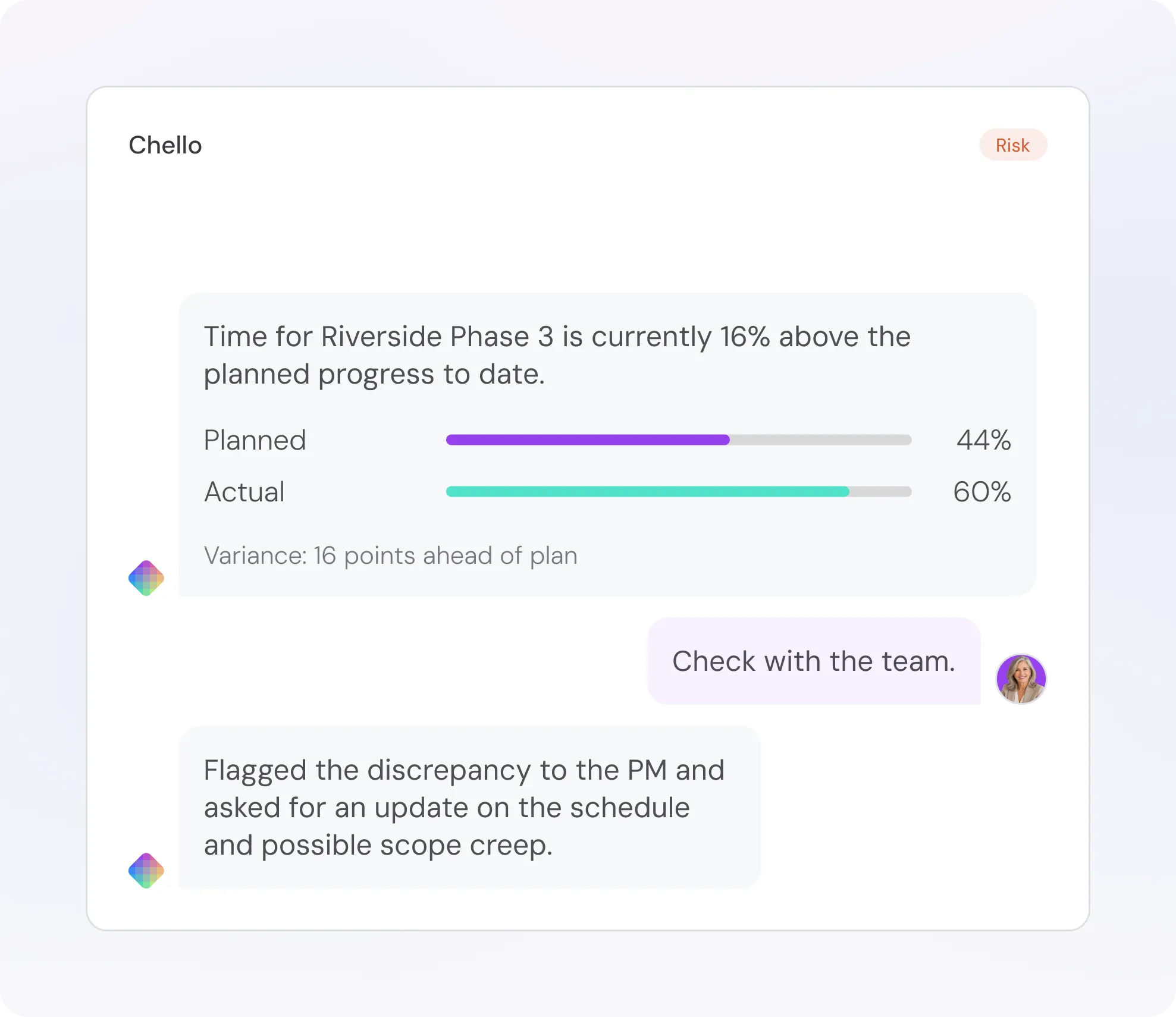
Chello, Mosaic’s AI planning assistant, keeps a brief on scope creep that looks at time, budget and schedule variance, and checks with the team when a phase runs ahead of plan.
How do consulting firms handle scope creep on fixed-fee engagements?
The same way, at the level of the engagement: a budget by phase in hours and fees, the consultants planned against it, and a weekly look at actual hours. The engagement manager raises added scope with the client while it’s still small, and the change is priced or absorbed on purpose.
Resource management software for consulting firms · Project margin and budgets for services firms
How do you raise scope creep with a client?
Early, and with the numbers: which requests fell outside the agreed scope, what they cost in hours, and the options, from a priced scope change to a trade for other work. Clients take that conversation better in week three than at the final invoice.
What else do firms ask about scope creep?
What is scope creep?
Work that grows beyond what a project’s fee and scope covered, usually in small requests rather than one big change. On a fixed fee, it comes straight out of the profit.
How often should a firm check for scope creep?
Weekly, by phase. Monthly checks find it after the hours are spent, when the options are fewer.
Does Mosaic flag projects running over budget?
Yes. Mosaic compares planned and actual hours with each project’s budget and flags projects trending over budget, weeks before month end.
Does Mosaic do invoicing or accounting?
No. Mosaic plugs into your ERP or other finance or invoicing software, which keeps billing and accounting, and Mosaic plans the work: who works on which project, phase by phase. We feel business operations command their own software platform.
Book a 20-minute demo
See which fixed-fee projects are running ahead of their budget, starting from your own projects.