

Resource planning for PE-backed professional services firms
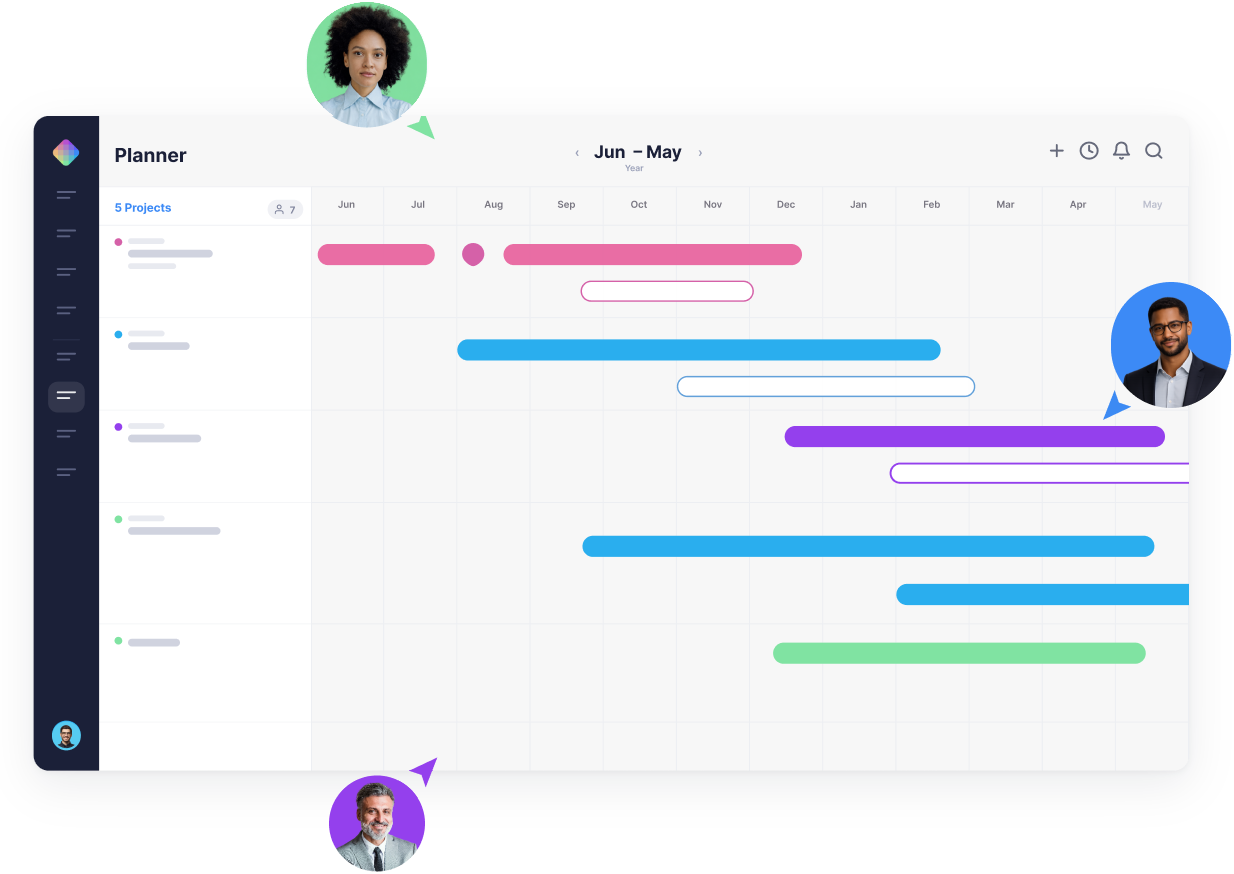
This is the private equity playbook for increasing the value of a professional services firm. Its labor costs are mostly fixed, so utilization is the one lever an owner can really improve, and it is won or lost in the plan, weeks before the month closes. Mosaic, an AI project and resource planning tool, gives each firm in a buy-and-build platform one live plan for its people and projects, starting from the data in its ERP, and gives the platform one view across every firm.
Private equity now makes nearly half of US design firm acquisitions: PE and PE-backed buyers made 47% of US design and environmental firm deals through mid-September 2025, up from 12% in 2016, according to Morrissey Goodale. And with multiples doing less of the work, a buyout now needs EBITDA growth closer to 10% to 12% a year, against about 5% a decade ago, according to Bain. In a services firm, much of that growth is won or lost in the plan for its people, which at most firms we see lives in spreadsheets and the ERP’s light planning module. We make Mosaic, so this page sets out where it fits.
What does a PE-backed firm need from resource planning?
A view of the next quarter, not only the last one: who is working on what, how much of their time is billable, and when the firm needs to hire. Costs in a services firm are mostly fixed, so billable time goes straight to margin, and the plan is where billable time is won or lost.
| What matters | Spreadsheets and ERP modules | Mosaic |
|---|---|---|
| Utilization | Reported after the month closes | Projected weeks ahead, by person, role, office and firm |
| Forecasts | Built by hand, firm by firm | Revenue, utilization and hiring from the live plan |
| Across the platform | Each firm’s own spreadsheets and ERP | One view across every firm, even on different ERPs |
| Hiring | Decided when people are already overloaded | Demand by role against capacity shows when to hire |
| A new acquisition | Another set of spreadsheets to reconcile | Data imported typically within 48 hours, live in 30 to 60 days |
| Security | Varies by firm | SOC 2 Type II, read-only ERP credentials and single sign-on |
What does the platform see when every firm plans in Mosaic?
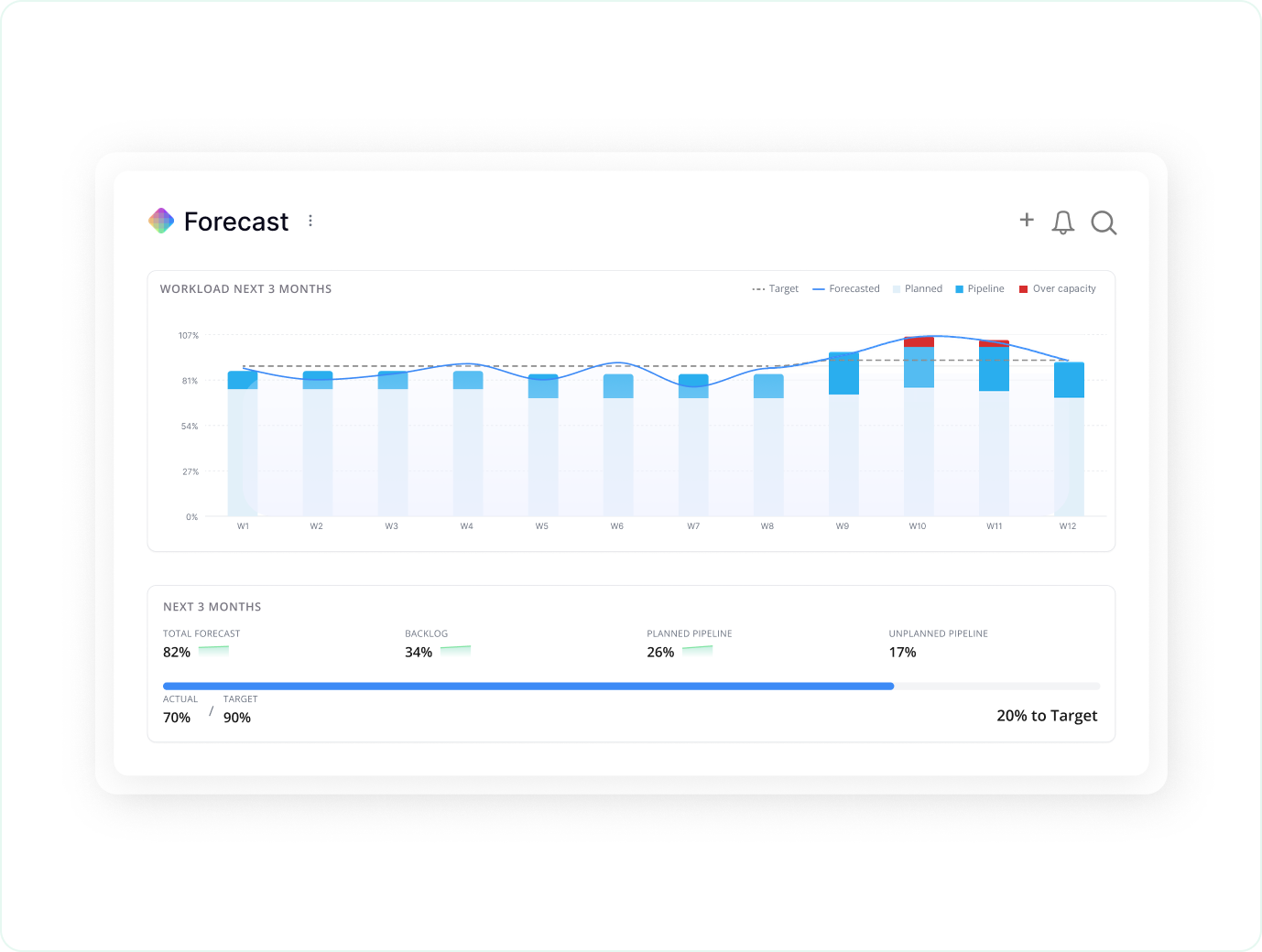
The same numbers for every firm, weeks ahead: projected utilization, revenue by month, and where people are short or free. Each firm keeps its ERP and plans in its own views, and the platform reads one set of figures across all of them.
The board stops waiting for the month to close to find out how it went.
Last month’s utilization, rolled up by hand from each firm’s spreadsheets.
One live view of every firm’s people, projects and forecasts.
What the platform sees in Mosaic:
- Projected utilization by firm, office and role
- Revenue by month from the planned hours
- Hiring needs by role, across firms
- Projects at risk on budget or deadline, flagged early
- Every acquired firm in the same view
What should operating partners ask about a portfolio firm’s resource planning?
Seven questions show whether a firm can see its next quarter, or only its last one.
- What share of billable capacity is planned for the next four weeks?
- How far ahead can the firm see projected utilization, by person, role and office?
- How does the firm decide when to hire, and how early?
- How close did last quarter’s forecast come to what happened?
- What share of revenue is hourly, fixed fee or audited cost-plus?
- Who keeps the plan current, and how often?
- How long would it take to see an acquired firm’s people next to everyone else’s?
Why do PE-backed firms plan in Mosaic?
PE-backed firms plan in Mosaic because it reads each firm’s ERP as it is, shows every firm in one view and forecasts from the live plan.

An ERP integration we build and run
Enterprise grade, with 99.9% reliability: Mosaic integrates with any ERP, reads projects, people, roles, rates, budgets and actual hours from it, and maintains the connection itself.

Every add-on in one plan
Each add-on acquisition joins the same plan on whichever ERP it runs, so the platform reports one set of numbers.

A forecast the board can trust
Revenue, utilization and hiring from the live plan. Within four months, a firm’s next-quarter forecast can be accurate to within about 3% to 4%.

Live in 30 to 60 days
Data imported typically within 48 hours, and the ERP integration in place within days, for each firm the platform adds.
A plan that stays current
Chello, Mosaic’s AI planning assistant, asks each manager for updates in Microsoft Teams and changes nothing without approval.

Security a holding company expects
SOC 2 Type II, encrypted read-only ERP credentials, single sign-on, and AI that is never trained on your data.
How does resource planning create value in a PE-backed firm?
Resource planning creates value by raising utilization. Five more points of utilization is worth $1m to $2m a year in bottom-line profit per 100 people, according to the Resource Management Institute.
Labor costs in a services firm are mostly fixed, so where the freed hours bill, most of that gain falls to EBITDA. At the low end of that range, an 800-person platform gains about $1.6m a year for each point, roughly one point of margin at the 2026 medians in Deltek’s Clarity study and PSMJ’s benchmark survey. At the 5.4x median EBITDA multiple ROG+ reports for architecture and engineering firm sales, that’s about $8.6m of value.
The plan is also where hiring is decided. Demand by role against capacity, weeks ahead, shows whether the next hire is needed, or whether someone in another firm is free.
When does a point of utilization reach EBITDA?
Three conditions decide how much of a utilization point becomes EBITDA, and a buyer’s diligence team will test all three. It pays to know a platform’s mix before setting a target.
| Condition | Where the point reaches EBITDA | Where it does less |
|---|---|---|
| Demand | Backlog to fill the freed hours. Engineering firms carry a median of 12 months of backlog, and 88% have open positions. | Soft demand, where the point shows up as hires the firm doesn’t make rather than new revenue |
| Contract type | Hourly and time-and-materials work, where billable hours are revenue | Fixed fees, where the gain shows as fewer hours per project, and audited cost-plus work, where indirect cost rates reset each year on direct labor |
| Persistence | A gain that sits in trailing earnings, measured against a baseline agreed before the work started | A run-rate claim built in the last year of the hold |
How should a platform prove the gain?
A utilization gain shouldn’t be taken on faith, ours included. Agree the baseline first, prove planning adoption in the first 90 days, then read utilization at six and twelve months.
Start early in the hold, so the gain reaches trailing earnings before exit. In FTI Consulting’s words, firms that wait until the last twelve months are “presenting buyers with a pitch deck, not evidence.”
- Agree the baseline: utilization by firm, office and role over the last twelve months, measured the same way in every firm.
- Days 1 to 90: prove adoption, measured as the share of billable capacity planned four weeks ahead, firm by firm.
- Month six: read utilization against the baseline, with each firm’s contract mix beside it.
- Month twelve: the gain sits in trailing earnings, with the plan’s history as the evidence.
What results have project-driven firms seen with Mosaic?
Firms on Mosaic plan 80% or more of their billable staff capacity, against under 50% at typical firms on ERPs and spreadsheets, and a quarter of them report their most profitable year ever. CPL, which has grown by acquisition, spends 75% less time managing resources on Mosaic, and CetraRuddy went from 77% to 90% utilization in its best year in 38 years.
Source: Mosaic planning data · CPL and CetraRuddy, Mosaic customers
80%+
of billable staff capacity planned at firms on Mosaic
75%
less time managing resources at CPL
90%
utilization at CetraRuddy, up from 77%
How does an add-on acquisition get onto Mosaic?
Each acquired firm is live in 30 to 60 days, in the same four steps, so value creation doesn’t wait for a systems project.
Mosaic imports each acquired firm’s data, typically within 48 hours, and the ERP integration is in place within days. Firms are trained and live in 30 to 60 days.
Resource planning for roll-ups · Resource planning that works with your ERP · Mosaic vs. ERPs
- Mosaic imports the acquired firm’s data, typically within 48 hours.
- Mosaic connects to the ERP the firm runs, whichever it is, and the integration is in place within days.
- Managers are trained and plan the next few weeks, and the firm is live in 30 to 60 days.
- The platform sees the new firm’s people and projects next to everyone else’s, and can share people across firms.

“Knowing in advance when you’re going to need to hire in order to meet future backlog is to some extent the holy grail of the professional services industry.”
For firms that live and die by planning
Mosaic is for project-driven firms that value project and resource planning, management and forecasting. When people are your most valuable resource, and they determine what you can get done and when, you want the best tool for the job: one that gives you control over delivery when deadlines matter. Without one, firms leave $10k to $20k per employee on the table every year: the profit in five more points of utilization, according to the Resource Management Institute. And there’s much more to lose.
How is Mosaic priced?
Mosaic is priced in annual parts: a per-seat subscription, a platform fee and an optional ERP integration, which Mosaic owns and maintains. Onboarding and implementation is a one-time cost, scoped to the firm’s rollout, and the team sets out all of it in one quote. Firms who plan on Mosaic typically see 10 to 20x ROI in a full year, and full-priced plans are backed by a 5x money-back guarantee. The return comes from staffing projects before the work starts rather than after.
The per-seat rate steps down as headcount increases, and the platform fee funds onboarding, training, a Customer Success Manager, support and hosting.
Speak to the team to learn more.
What else do PE-backed firms ask about Mosaic?
Does Mosaic replace each firm’s ERP?
No. Each firm’s ERP stays the system of record for time, billing and accounting, and Mosaic reads from it. Nothing goes back unless the firm sets it up with Mosaic’s API.
Can firms on different ERPs plan in one place?
Yes. One Mosaic plan can read from several ERPs at once, so an acquired firm can keep its own ERP and still plan in the same view.
Should a firm wait until an acquisition settles?
Usually not. Mosaic sits beside the ERP the firm already runs and is live in 30 to 60 days, so planning improves while the integration runs, not after it.
Who can see each firm’s people, rates and projects?
Each person sees what their role allows. Permissions are role-based, so planners can update schedules while cost rates and compensation stay restricted, and Chello follows the same permissions.
Does a utilization gain count the same on fixed-fee and cost-plus work?
No. On hourly work, more billable hours are more revenue. On fixed fees, the gain shows as fewer hours per project, which pays off when the freed people move to other work. On audited cost-plus work, indirect cost rates reset each year on a direct labor base, so a utilization change also moves the audited rate.
Should a sponsor mandate one planning tool across its platform?
Usually not, because mandates rarely win buy-in. A platform can make Mosaic the default for each new add-on and let each existing firm’s leaders decide when to move, with the numbers from the firms already planning on it in front of them.
Should a platform build its own planning tool?
Some sponsors build, and capitalized development can flatter EBITDA on paper. Buyers normalize it back to cash EBITDA at exit, though, and in MIT’s 2025 study of enterprise AI projects, tools bought from specialized vendors succeeded about 67% of the time, while internal builds succeeded a third as often.
Does Mosaic work for firms outside architecture and engineering?
Yes. Consultancies, agencies and IT services companies plan on Mosaic too: any project-driven business that sells its people’s time.
Book a 20-minute demo
See every firm’s people, projects and forecasts in one plan, starting from the data in each firm’s ERP.