

Resource planning for roll-ups: one plan across every acquired firm
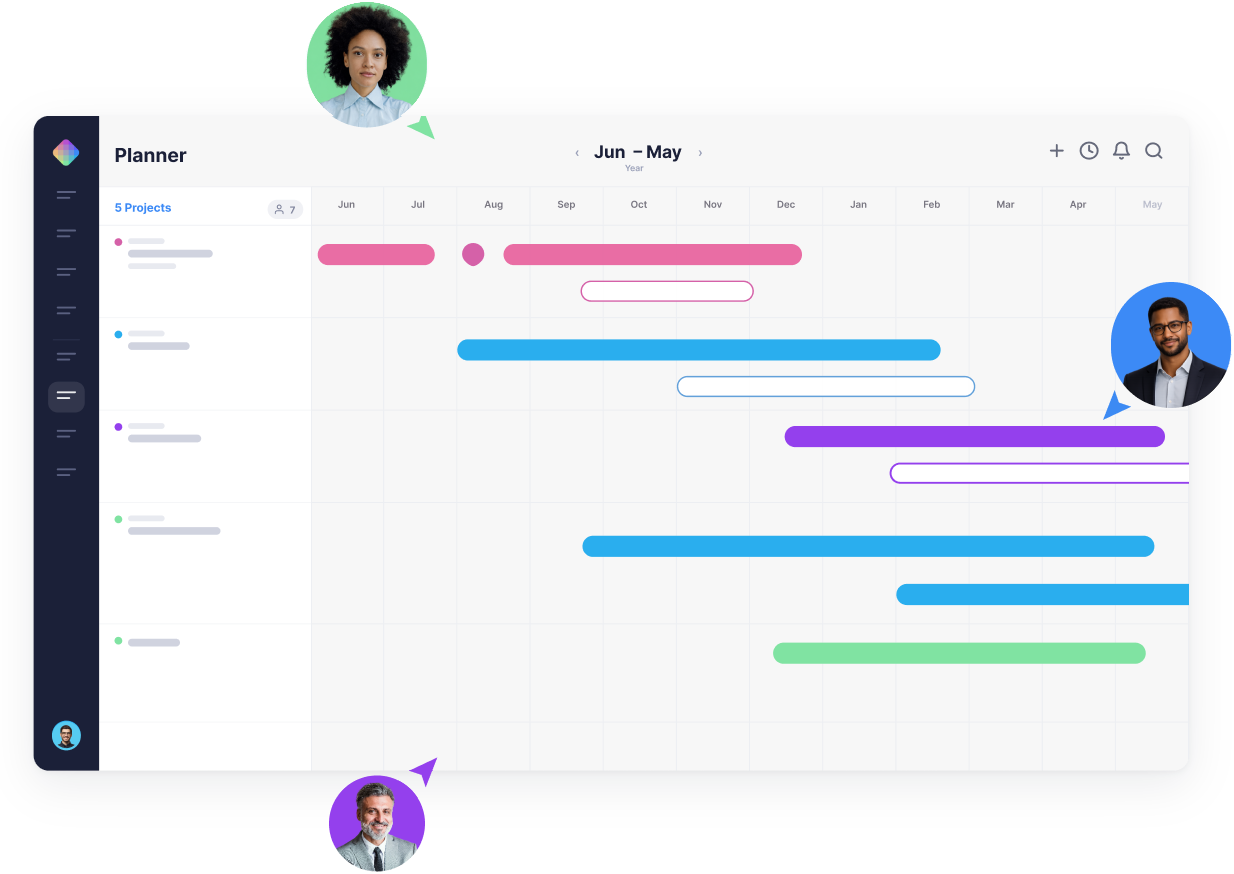
A PE-backed roll-up buys firms faster than it can bring their planning together. Each acquired architecture, engineering or consulting firm keeps its own spreadsheets, its own staffing meeting and, often, its own ERP. Mosaic, an AI project and resource planning tool, brings every acquired firm into one live plan, even when they run different ERPs, so the platform can share people across firms and forecast as one business.
Integration plans usually start with the books. The plan for people and projects comes later, if at all, and that is where the growth from an acquisition is meant to come from. We make Mosaic, so this page sets out how roll-ups use it.
What changes when a roll-up plans in one place?
Each firm stops planning on its own, without giving up its ERP or the way its teams work. The platform gets one set of numbers, people can move to the work across firms, and finance sees whether existing people can cover the work before it approves a hire.
| What matters | Each firm on its own | Every firm in Mosaic |
|---|---|---|
| The plan | Its own spreadsheets, meetings and definitions | One live plan, with utilization measured the same way in every firm |
| ERPs | Consolidated over years | Read as they are, several at once |
| Sharing people | Phone calls between offices | Who is free across every firm, by role and skill |
| Utilization | Rolled up by hand each month | Projected weeks ahead, firm by firm and as one |
| Hiring | Each firm hires for itself | Demand by role across the platform shows where to hire, or who to share |
| A new acquisition | Another set of spreadsheets to reconcile | Data imported typically within 48 hours, live in 30 to 60 days |
Can one plan work when every acquired firm plans differently?
Yes, when the plan fits how each team works. Mosaic’s views, workflows and reports can be tailored, so each acquired firm keeps the view it needs while the platform reads one set of numbers.
Chello, Mosaic’s AI planning assistant, asks each manager for updates in Microsoft Teams and changes nothing without approval.
Its own spreadsheets, staffing meeting and idea of who is available.
One live plan, with each firm planning in its own views.
What the platform gets:
- One view of every firm’s people and projects
- Utilization measured the same way in every firm
- People lent across firms and offices for a phase
- Forecasts for each firm and for the whole platform
- Each firm’s ERP left in place
What does a roll-up need from resource planning?
A roll-up needs a plan that reads each firm’s ERP, shows who is available across firms and gives one set of numbers.

An ERP integration we build and run
Enterprise grade, with 99.9% reliability: Mosaic integrates with any ERP, reads projects, people, roles, rates, budgets and actual hours from it, and maintains the connection itself.

Several ERPs, one plan
Each firm keeps its ERP, and the platform plans in one view.

Live in 30 to 60 days
Each acquired firm’s data imported typically within 48 hours, and the ERP integration in place within days.

People shared across firms
Leaders see who is free across every firm by role and skill, and lend people for a phase.
One set of numbers
Utilization, revenue and hiring, projected weeks ahead, for each firm and for the platform.

Security a holding company expects
SOC 2 Type II, encrypted read-only ERP credentials, single sign-on, and AI that is never trained on your data.

Do we have to consolidate ERPs before planning together?
No. One Mosaic plan can read from several ERPs at once, so an acquired firm can keep its own ERP and still plan in the same view. ERP consolidation can follow on its own schedule, while the platform plans as one business from the start.
Each firm’s ERP stays the system of record for its time, billing and accounting, and nothing goes back to it unless the firm sets it up with Mosaic’s API.
How should the platform prove the gain?
A utilization gain shouldn’t be taken on faith, ours included. Agree the baseline first, prove planning adoption in the first 90 days, then read utilization at six and twelve months.
Start early in the hold, so the gain reaches trailing earnings before exit. In FTI Consulting’s words, firms that wait until the last twelve months are “presenting buyers with a pitch deck, not evidence.”
- Agree the baseline: utilization by firm, office and role over the last twelve months, measured the same way in every firm.
- Days 1 to 90: prove adoption, measured as the share of billable capacity planned four weeks ahead, firm by firm.
- Month six: read utilization against the baseline, with each firm’s contract mix beside it.
- Month twelve: the gain sits in trailing earnings, with the plan’s history as the evidence.
What results have firms seen with Mosaic?
Firms on Mosaic plan 80% or more of their billable staff capacity, against under 50% at typical firms on ERPs and spreadsheets, and a quarter of them report their most profitable year ever. CPL, which has grown by acquisition, spends 75% less time managing resources on Mosaic, and CESO, a national A&E firm, nearly doubled in size from 2023 while planning on Mosaic, and more than 500 of its people now plan on it.
Source: Mosaic planning data · CPL and CESO, Mosaic customers
80%+
of billable staff capacity planned at firms on Mosaic
75%
less time managing resources at CPL
500+
people planning on Mosaic at CESO, a national A&E firm
How does each acquisition get onto Mosaic?
Each acquired firm is live in 30 to 60 days, in the same four steps, so integration doesn’t wait for a systems project.
Mosaic imports each acquired firm’s data, typically within 48 hours, and the ERP integration is in place within days. Firms are trained and live in 30 to 60 days.
Resource planning for PE-backed firms · Resource planning that works with your ERP · The resource management maturity model
- Mosaic imports the acquired firm’s data, typically within 48 hours.
- Mosaic connects to the ERP the firm runs, whichever it is, and the integration is in place within days.
- Managers are trained and plan the next few weeks, and the firm is live in 30 to 60 days.
- The platform sees the new firm’s people and projects next to everyone else’s, and can share people across firms.

“Previously you’d have to make a phone call and ask 10 questions to try to get to the answer. This shortcuts that substantially.”
For firms that live and die by planning
Mosaic is for project-driven firms that value project and resource planning, management and forecasting. When people are your most valuable resource, and they determine what you can get done and when, you want the best tool for the job: one that gives you control over delivery when deadlines matter. Without one, firms leave $10k to $20k per employee on the table every year: the profit in five more points of utilization, according to the Resource Management Institute. And there’s much more to lose.
How is Mosaic priced?
Mosaic is priced in annual parts: a per-seat subscription, a platform fee and an optional ERP integration, which Mosaic owns and maintains. Onboarding and implementation is a one-time cost, scoped to the firm’s rollout, and the team sets out all of it in one quote. Firms who plan on Mosaic typically see 10 to 20x ROI in a full year, and full-priced plans are backed by a 5x money-back guarantee. The return comes from staffing projects before the work starts rather than after.
The per-seat rate steps down as headcount increases, and the platform fee funds onboarding, training, a Customer Success Manager, support and hosting.
Speak to the team to learn more.
What else do roll-ups ask about Mosaic?
How long does it take to bring an acquired firm onto Mosaic?
Mosaic imports each acquired firm’s data, typically within 48 hours, and the ERP integration is in place within days. Firms are trained and live in 30 to 60 days.
Who can see each firm’s people, rates and projects?
Each person sees what their role allows. Permissions are role-based, so planners can update schedules while cost rates and compensation stay restricted, and Chello follows the same permissions.
Can people be shared across acquired firms?
Yes. Leaders see who is free across every firm by role and skill and lend people for a phase, so hiring in one firm and spare capacity in another stop being separate conversations.
Does each firm have to change how it plans?
No. Each firm keeps views, workflows and reports tailored to its teams, and the platform sees utilization measured the same way across every firm.
Does a utilization gain count the same on fixed-fee and cost-plus work?
No. On hourly work, more billable hours are more revenue. On fixed fees, the gain shows as fewer hours per project, which pays off when the freed people move to other work. On audited cost-plus work, indirect cost rates reset each year on a direct labor base, so a utilization change also moves the audited rate.
Is Mosaic SOC 2 Type II?
Yes. Mosaic is SOC 2 Type II, uses encrypted, read-only ERP credentials and single sign-on, and its AI is never trained on your data.
Book a 20-minute demo
See every acquired firm’s people and projects in one plan, starting from the data in each firm’s ERP.