

Resource planning with BST Global
Mosaic, an AI project and resource planning tool, plugs into BST Global, so larger architecture and engineering firms can plan people across offices, disciplines and projects. BST Global stays the system of record, and Mosaic reads what planning needs from it.
What do firms on BST Global use for resource planning and staff scheduling?
Many firms on BST Global add a planning tool rather than replace the ERP, and Mosaic plugs into BST Global for that: BST Global stays the system of record, and resources and schedules are planned in Mosaic. That way every office works from the same plan, built from what planning needs in BST Global.
ERPs record what happened. Mosaic helps you run the firm.
Mosaic plugs into your ERP. Billing and accounting stay in BST Global, where your finance team runs them.

What data does Mosaic take from BST Global?
Mosaic reads projects, phases, people, roles, budgets and fees, and time from BST Global, so nobody keys them into a second system. BST Global stays the system of record for the books, and planning, staffing and forecasting happen in Mosaic.
A bi-directional BST Global integration is coming soon.
Mosaic pulls from BST Global four times a day. For core data, the connection can refresh as often as every minute.

Schedules by phase
Each project gets its phases, a schedule on the timeline and hours by role, planned in Mosaic.

Offices and disciplines
Offices, departments and disciplines are tags in Mosaic, so leaders can see the plan by any of them.

Actual hours
Recorded time shows actual hours against the plan, and utilization by person, role, department and office.
Why do larger firms on BST Global add a planning tool?
Planning who works on what next, across many offices and disciplines, needs a plan every PM updates each week, and an ERP is built to record what already happened. With the plan in Mosaic, leaders see capacity by office, discipline and role weeks ahead, instead of assembling it from each office’s spreadsheet.
Chello, Mosaic’s AI planning assistant, asks each PM for updates in Microsoft Teams. Most firms on Mosaic get most of their people planning. The only thing that gets everyone planning is the Teams integration.
How do larger firms plan people across offices and disciplines?
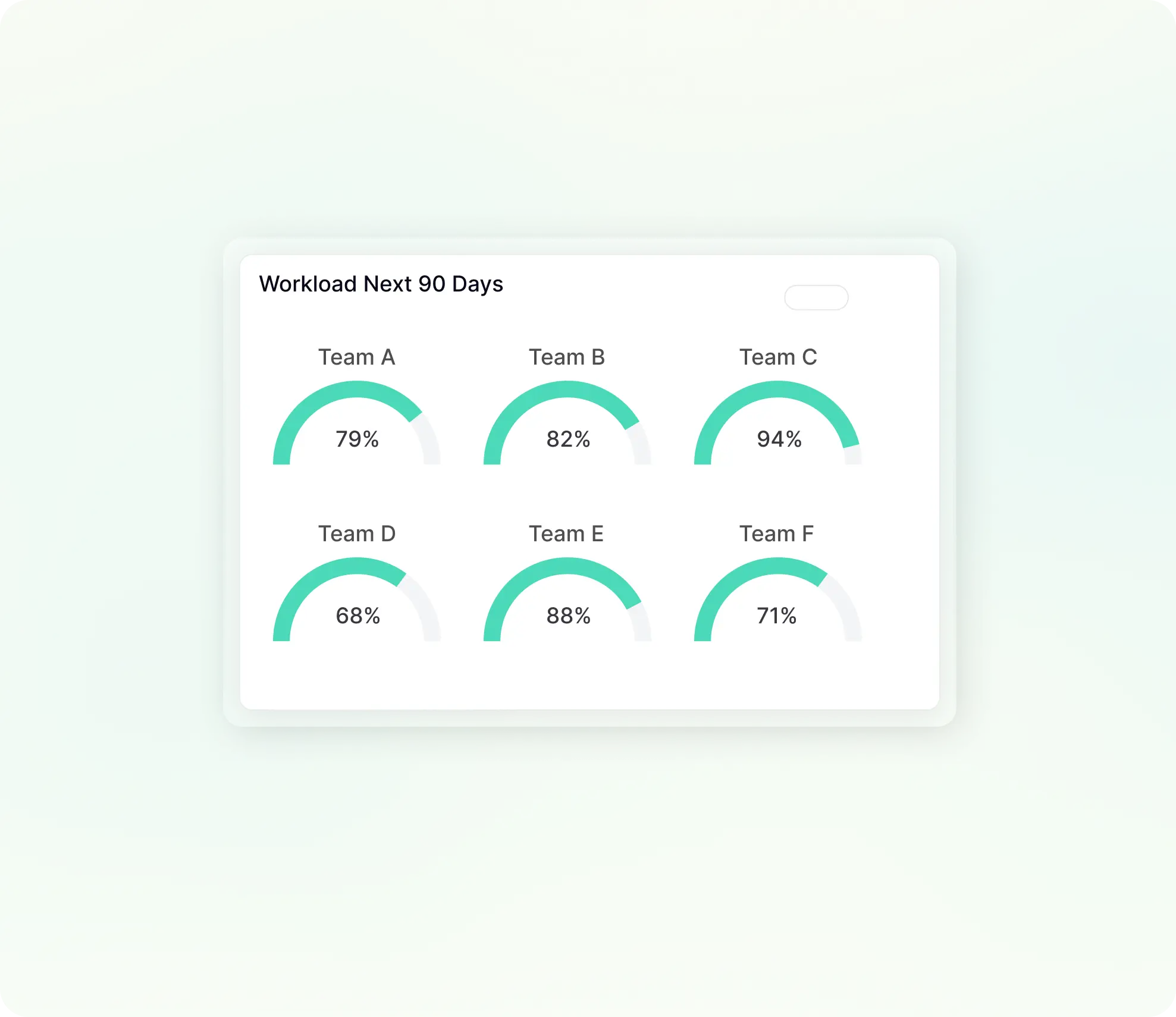
Larger firms on BST Global plan every office, region and discipline in one Mosaic plan, so a team short on staff sees who is free in another office and borrows them for a phase. Leaders compare capacity and utilization by office, department and discipline in one view.

“As a PM group, we meet every Thursday and go through each person individually on Mosaic to help when people get overloaded and make sure their workload is balanced.”
How do PMs and principals work from BST Global data in Mosaic?
PMs plan each BST Global project by phase in Mosaic, with schedules, hours by role, staffing and budgets, and track planned hours against actual hours. Principals see every project, deadline and person across the firm in one view, with schedule variance showing which projects are at risk.
Forecasts built from the live plan, so you see what’s coming while there’s still time to change it.
| Who | What they plan and see in Mosaic |
|---|---|
| Project managers | Phases, schedules, budgets and staffing for their projects, with planned against actual hours |
| Principals | Every project, deadline and person in one view, with portfolios for the projects they oversee |
| Operations leaders | Who’s free by office, discipline and role, and where work can move |
| Finance | Utilization by office and role, and revenue and headcount forecasts built from the live plan |
What does IT review before connecting BST Global?
IT at a larger firm usually reviews security certification, what the connection reads, how permissions work, and how AI assistants get access to the data. Mosaic is SOC 2 Type II and owns the upkeep of the BST Global connection, so it doesn’t land on your IT staff’s list.
Mosaic’s MCP server, the connection that lets an AI assistant such as Claude or ChatGPT work with Mosaic’s data, is how assistants reach the plan. AI assistants connected through Mosaic’s MCP server act within the permissions of the person who connected them.
- SOC 2 Type II
- Mosaic reads what planning needs from BST Global
- Permissions: access defaults to locked, and planning gets gated
- Setup and upkeep handled by Mosaic
What have firms gained from planning in Mosaic?
CetraRuddy went from 77% to 90% utilization and had its best year in 38 years, and at CESO production-staff utilization rose 2 points. CPL spends 75% less time managing resources, and Vocon went from 49% to 94% of its capacity planned in 12 months.
Source: CetraRuddy, CESO, CPL and Vocon, Mosaic customers
90%
utilization at CetraRuddy, up from 77%
+2
points of production-staff utilization at CESO
75%
less time managing resources at CPL
How does pricing work for a larger firm on BST Global?
For a larger firm on BST Global, Mosaic is priced in three annual parts: a per-seat subscription, a platform fee and the BST Global integration, which Mosaic owns and maintains. Onboarding and implementation is a one-time cost, scoped to the firm’s rollout, and the team sets out all of it in one quote. Firms who plan on Mosaic typically see 10 to 20x ROI in a full year. The return scales with utilization: at a larger firm, each point of utilization is worth more billable hours.
The per-seat rate steps down as headcount increases, and the platform fee funds onboarding, training, a Customer Success Manager, support and hosting.
Full-priced annual contracts are backed by a 5x money-back guarantee. Speak to the team to learn more.
What else do firms on BST Global ask?
Does Mosaic integrate with BST Global?
Yes. Mosaic plugs into BST Global for what planning needs, and the books stay in BST Global.
Can Mosaic plan across all our offices?
Yes. Every office, region, department and discipline sits in one plan, so leaders see capacity across the firm and teams can borrow people from other offices.
Can we see utilization by office and role?
Yes. Utilization can be viewed by person, role, department and office, planned from the schedule and actual from recorded time.
Do PMs need much training?
Firms are integrated, trained and live in 30 to 60 days. After that, Chello in Microsoft Teams asks PMs for updates, and one reply gets the plan to match reality.
Can one plan read from more than one ERP?
Yes. One Mosaic plan can read from several ERPs at once, for firms that run two after an acquisition or a merger.
Is Mosaic SOC 2 Type II?
Yes. Mosaic is SOC 2 Type II, and permissions decide what each person, and each AI assistant acting for them, can see and change.
Book a 20-minute demo
See every office’s projects and people in one Mosaic plan, alongside BST Global.